Guidelines for Selecting Materials and Coatings
In the discussion and charts of this section, Simpson Strong-Tie presents a three-step system to determine which product coatings and base metals to use in a range of corrosion conditions. These are general guidelines that may not consider all relevant application criteria. Refer to product-specific information for additional guidance.
Simpson Strong-Tie evaluated the AWPA Use Categories (See AWPA U1-16) and ICC-ES AC257 Exposure Conditions and developed a set of corrosion resistance recommendations. These recommendations address the coating systems and materials used by Simpson Strong-Tie for fastener, connector, and anchor products. Although the AWPA Use Categories and ICC-ES AC257 Exposure Conditions specifically address treated-wood applications and some common corrosion agents, Simpson Strong-Tie believes that its recommendations may be applied more generally to other application conditions, insofar as the service environments discussed are similar. You should consult with a corrosion engineer concerning the application where advisable.
Guidelines for Selecting Materials and Coatings
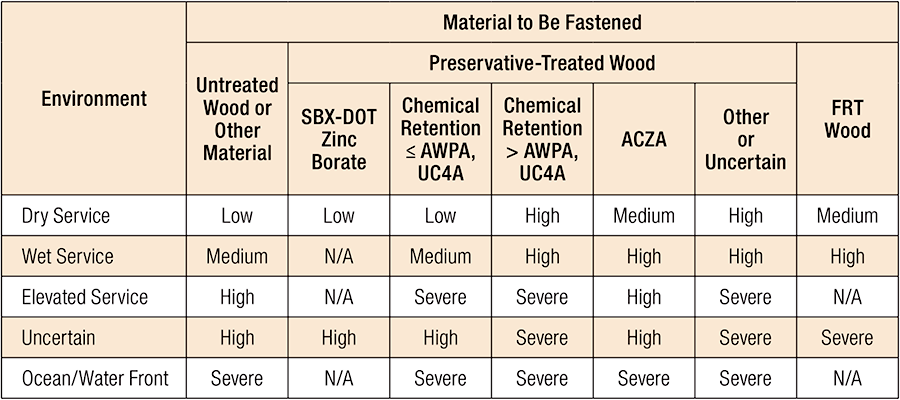
Step 1 of 3 — Evaluate the Corrosion Conditions
Dry Service
Generally INTERIOR applications including wall and ceiling cavities, and in raised floor applications in enclosed buildings that have been designed to prevent condensation and exposure to other sources of moisture. Prolonged periods of wetness during construction should also be considered, as this may constitute a Wet Service or Elevated Service condition. Dry Service is typical of AWPA UC 1 and UC 2 for wood treatment and AC257 Exposure Condition 1. Keep in mind that dry-service environment may contain airborne salts. AC257 Exposure Condition 2 reflects the presence of airborne salt in a dry-service environment and corrosion hazard to exposed metal surfaces. It does not include effects of treatment chemicals. This condition is generally considered in Elevated and Uncertain assessments.
Wet Service
Generally EXTERIOR construction in conditions other than elevated service. These include Exterior Protected and Exposed and General Use Ground Contact as described by AWPA UC4A. The AWPA U1 standard classifies exterior above-ground treatments as Use Categories UC 3 (A and B) depending on moisture run-off; and for exterior ground-contact levels of protection, it has Use Categories UC 4 (A-C). ICC-ES AC257 considers the exterior exposure to be limited by the presence of treatment chemicals, and corrosion accelerators. In general, the AC257 Exposure Condition 1 includes AWPA Use Categories UC 1 (interior/dry) and UC 2 (interior/ damp), while Exposure Condition 3 is a surrogate to UC3A, 3B, and 4A (exterior, above-ground and ground-contact, general use). The ICC-ES AC257 Exposure Conditions 2 and 4 are exposures that are salt environments.
Elevated Service
Includes fumes, fertilizers, soil, some preservative-treated wood (AWPA UC4B and UC4C), industrial-zone atmospheres, acid rain, salt air, and other corrosive elements.
Uncertain
Unknown exposure, materials, or treatment chemicals.
Ocean/Water Front Service
Marine environments that include airborne chlorides, salt air, and some salt splash. Environments with de-icing salts are included.
Step 2 of 3 — Determine Your Corrosion Resistance Classification
Corrosion Resistance Classification
Additional Considerations
- Always consider the importance of the connection as well as the cost of maintenance and replacement.
- Simpson Strong-Tie has evaluated the corrosion effects of various formulations of wood treatment chemicals ACZA, ACQ, CCA, MCA, CA, and salt as corrosion accelerators. Simpson Strong-Tie has not evaluated all formulations and retentions of the named wood treatment chemicals other than to use coatings and materials in the severe category. Manufacturers may independently provide test results or other product information. Simpson Strong-Tie expresses no opinion regarding such information.
- Type 316/305/304 stainless-steel products are recommended where preservative-treated wood used in ground contact has a chemical retention level greater than those for AWPA UC4A; CA-C, 0.15 pcf (pounds per cubic foot); CA-B, 0.21 pcf; micronized CA-C, 0.14 pcf; micronized CA-B, 0.15 pcf; ACQ-Type D (or C), 0.40 pcf. When wood treated with micronized CA-C and micronized CA-B with treatment retentions up to UC4B is in dry service, hot-dip galvanized fasteners and connectors may be suitable.
- Mechanical galvanizations C 3 and N2000 should not be used in conditions that would be more corrosive than AWPA UC3A (exterior, above ground, rapid water run off).
- Some chemically treated wood may have chemical retentions greater than specification, particularly near the surface, making it potentially more corrosive than chemically treated wood with lower retentions. If this condition is suspected, use Type 316/305/304 stainless-steel, silicon bronze, or copper fasteners.
- Some woods, such as cedars, redwood, and oak, contain water-soluble tannins and are susceptible to staining when in contact with metal connectors and fasteners. Applying a quality finish to all surfaces of the wood prior to installation can help reduce staining.
- Anchors, fasteners and connectors in contact with FRT lumber shall be hot-dip galvanized or stainless steel, unless recommended otherwise by the FRT manufacturer. Many FRT manufacturers permit low-corrosion-resistant connector and fastener coatings for dry-service conditions.
- Simpson Strong-Tie does not recommend painting stainless-steel anchors, fasteners or connectors. Imperfections or damage to the paint can facilitate collection of dirt and water that can degrade or block the passive formation of the protective chromium oxide film. When this happens, crevice corrosion can initiate and eventually become visible as a brown stain or red rust. Painting usually does not improve the corrosion resistance of stainless steel.
Step 3 of 3 — Match Your Corrosion Resistance Classification to the Coatings and Materials Available
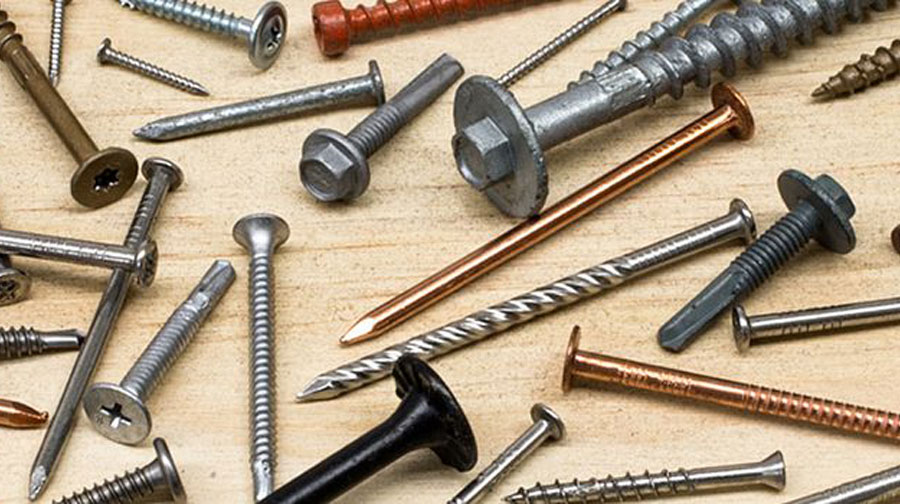
Simpson Strong-Tie connectors, anchors and fasteners feature a wide range of materials and coatings designed to meet specific performance criteria. It is important to select a material and/or coating that is suitable for the intended application and environment based upon factors such as corrosion resistance and mechanical properties of the material.
Not all products are available in all finishes. Contact Simpson Strong-Tie for product availability, ordering information and lead times.
Products In Contact With/Embedded In Concrete in Hawaii
Simpson Strong-Tie is aware of issues regarding corrosion around the perimeter of some slab-on-grade foundations in the State of Hawaii, related to steel products that are made by multiple manufacturers, and which are either in contact with, or embedded in, the concrete. As this has involved some of our products, Simpson Strong-Tie takes these instances seriously and has been investigating the causes of the corrosion.
In general, we have identified a number of factors that may contribute to the corrosion of steel products in contact with, or embedded in, some concrete slabs in Hawaii, including: misinstallation, the local environment, and construction practices and materials, including quality and composition of the concrete. Steel products in contact with, or embedded in, the foundation, such as bottom CFS tracks, anchor bolts, reinforcing bar, and steel straps and anchors have all been observed to be experiencing accelerated corrosion in some instances.
Consistent with its generally applicable guidelines and warnings, Simpson Strong-Tie recommends that builders work closely with their specifiers and corrosion engineers to make sure they understand the corrosion issues that may present themselves on any given project. Many environments and materials can contribute to corrosion, including ocean salt air, condensation, duration of wetness, chlorides, sulfates, preservative-treated wood, dissimilar metals, soils, and more. The building design and implementation, quality of construction, and incidents of misinstallation can directly affect the exposure to corrosive conditions of products in contact with, or embedded in, concrete. A product intended and installed for use in a dry-service environment may corrode if the structure design or building materials allow moisture intrusion, or expose the product to corrosive conditions, such as moisture or chemicals contained in the construction materials, soils, or atmospheres.
Specifiers should also take into consideration specifying the appropriate design mix for the concrete foundation and follow the durability provisions of the latest building code and the standards set forth by the American Concrete Institute. Chloride deposition rates for Hawaii should be considered as well as chloride content in the soils. Designers must take all of these factors into account when deciding which Simpson Strong-Tie products to use with which corrosion-resistant coatings or materials, especially when in contact with other materials such as concrete. For additional information on corrosion and corrosion resistance of Simpson Strong-Tie products, please go to strongtie.com/solutions/corrosion.
Please refer to the Hawaii Building Code regarding any restrictions related to the use of strap-tie hold down and mudsill anchor type products in Hawaii.
In order to obtain optimal performance from Simpson Strong-Tie products and achieve the allowable design load, as well as meet the requirements of Simpson’s limited warranty, the products must be properly installed and used in accordance with accepted design principles, the corrosion information, installation instructions, and design limits provided by Simpson Strong-Tie. For more information on Simpson Strong-Tie’s Warnings and Limited Warranty, please go to strongtie.com/information/limited-warranties.
Simpson has not seen the patterns of corrosion incidents referenced above outside of Hawaii. However, if you are aware of incidents of corrosion around the perimeter of slab-on-grade foundations occurring outside of Hawaii involving Simpson products, please contact the Simpson Strong-Tie Engineering department at (800) 999-5099. If you have additional questions or need further assistance regarding this matter, please contact our Hawaii representative at (808) 479-1216 or ask for the Simpson Strong-Tie Engineering department at (800) 999-5099.